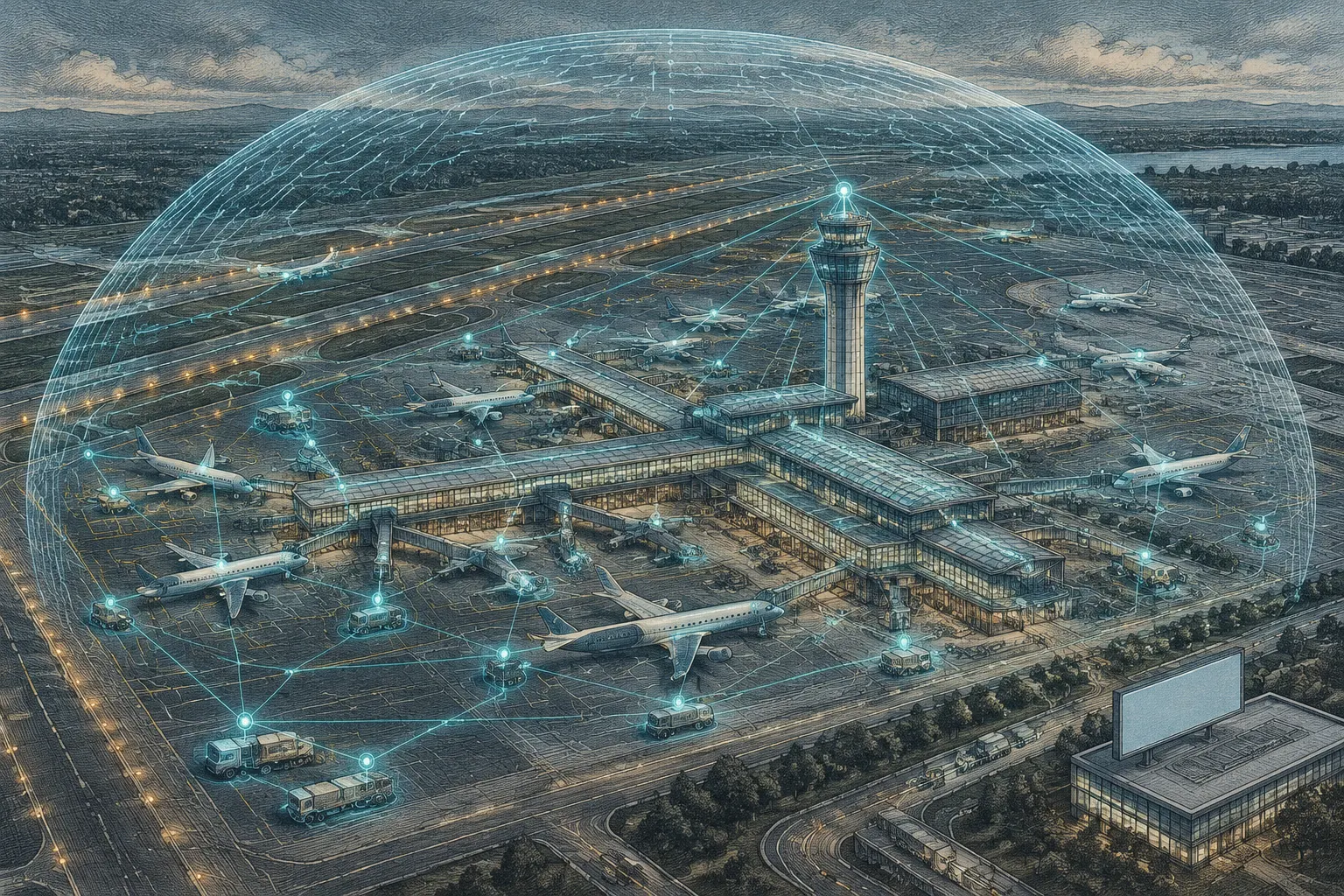
Frost & Sullivan's study Total Airport Management (TAM) Market, Global, 2025–2034 values the global market at $4.80 billion in 2025 and expects it to reach $10.36 billion by 2034, a compound annual growth rate of 8.9%. The firm states that global passenger traffic is expected to nearly double by 2045 while opportunities to add runways and terminals remain limited. Software accounts for the largest share of spending, ahead of hardware and services.
Airport simulation and digital twin platforms form the fastest-growing component, expanding at a CAGR of 13.9%, according to the study. Operators use these virtual replicas to test scenarios, train staff and validate safety, capacity and sustainability initiatives before committing capital. Frost & Sullivan reports that artificial intelligence is pushing the wider TAM stack beyond dashboards toward agents that anticipate disruptions and coordinate responses across airlines, ground handlers and air navigation service providers. Capacity management and planning also grows ahead of the overall market.
Implementation follows two paths. New airports in Asia-Pacific and the Middle East are adopting full-suite TAM as part of their original design, and these regions record the fastest growth and attract most new high-value contract awards. Mature airports tend to modernize piece by piece. The Americas generate more than a third of global revenue through modular, FAA-aligned upgrades such as surface collaborative decision-making, while Europe remains the benchmark for standardized, regulation-driven deployment.
The study finds that the main restraints affect the timing and sequencing of investment rather than its direction: every new sensor and data exchange widens the attack surface, the absence of a globally agreed TAM architecture raises integration costs, and airlines remain cautious about sharing proprietary turnaround data without a clear commercial benefit. Jason Buster, Industry Principal, Aerospace and Defense at Frost & Sullivan, said a complete understanding of the entire airport enterprise is crucial to successful implementation, and that airports should look beyond the Internet of Things toward the integration of things—people, process and technology working together.