A blockchain is a shared record kept by thousands of computers that must agree on which transactions happened and in what order. Until enough of the network has signed off, there is a small chance a transaction could be dropped or replaced if part of the network had a different view of events. Finality is the point where that chance is gone, or so small it can be ignored. Before it, a transaction is pending; after it, the transaction is settled.
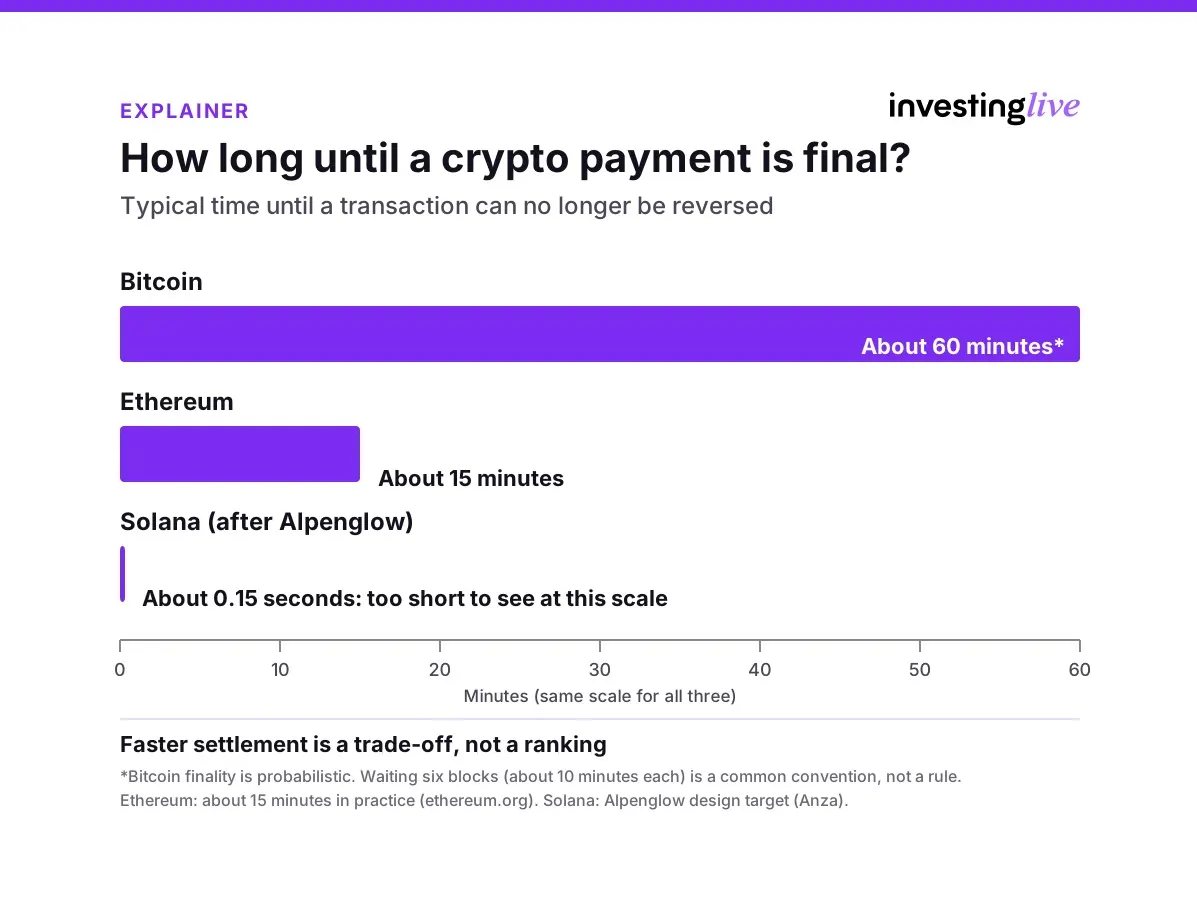
Bitcoin never declares a transaction final, according to the source. Instead, each new block added on top makes it harder to reverse, because rewriting history would mean redoing all the computing work in those later blocks. New blocks arrive about every 10 minutes on average, and a common convention is to wait for six confirmations, roughly an hour, before treating a large payment as settled, though many exchanges credit deposits after fewer. Since its move to proof-of-stake, Ethereum has had a definite finality point: validators vote on checkpoints, and once two-thirds of staked ETH has backed a checkpoint in two consecutive rounds, everything before it is finalized. In practice that takes about 15 minutes, according to ethereum.org.
Solana also uses staked validators but is designed for speed. Under its previous system, TowerBFT, transactions were quickly marked confirmed, but full finality took about 12.8 seconds. Alpenglow, live on mainnet since 21 October, merges those stages into one and targets finality of about 150 milliseconds, though early dashboard readings have been somewhat above that target.
Finality affects how quickly funds can be used. Exchanges usually wait for a transaction to settle before crediting a deposit, so slower finality means a longer wait before funds can be traded, a cost for anyone moving coins between exchanges to capture a price difference. It also matters for payments and decentralised finance, where a merchant or lending app acting before finality takes on a small risk of reversal. The source notes that speed is not the same as quality: Bitcoin's slower process is part of what makes its history hard to rewrite, Ethereum's longer window comes with a very large, widely distributed validator set, and Solana's speed relies on high-performance validators, with the network having a history of outages. This article was written by Eamonn Sheridan at investinglive.com.